
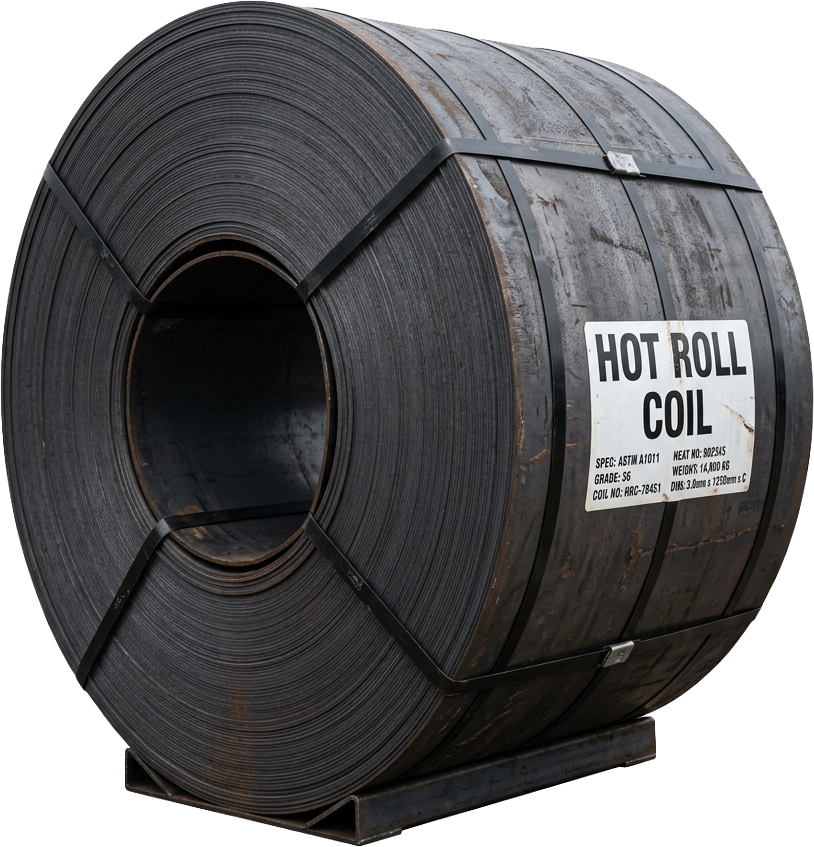
Hot Rolled Coil (HRC) Supplier in Pakistan
Hot rolled coil goes into welded pipe and tube, structural frames and general engineering. Rolling hot leaves mill scale on the surface and a wider thickness tolerance than cold rolled, with the weldability expected of a low-carbon structural grade. Raw Easy Corp imports and trades it from Moin Steel Market, Karachi.
Sizes Available:
| MM | Width | Grade |
|---|---|---|
| 3.0 mm | 1220/1500 | Q195/Q235 |
| 3, 4, 5, 6, 7, 8, 10 & 20 mm | 1220/1250/1500 | Q235 |
| 2.0, 2.3 & 2.5 mm | 1220/1250/1500 | 1006/Q235 |
| 0.8, 1.0, 1.2 & 1.5 mm | 1220/1250/1500 | Q235 |
| Attribute | Range / Standard |
|---|---|
| Product | Hot rolled coil and sheet, non-alloy steel |
| Thickness | 0.8 mm – 12.0 mm |
| Width | 1210 / 1250 / 1500 mm |
| Grades | Q195, Q235B, 1006 soft grade (GB/T 700); SS400 (JIS G3101); A36 (ASTM A36/A36M) |
| Surface | Mill finish with scale, or pickled and oiled (HRPO) |
| Edge | Mill edge or slit edge |
| PCT heading | 72.08 (flat-rolled, hot-rolled, width 600 mm or more) |
| Certification | Mill test certificate to EN 10204 (type as agreed at order) |
Hot rolled coil grades and what they are used for
| Grade | Standard | Typical use |
|---|---|---|
| Q195 | GB/T 700 | Low-strength forming, light sections, general fabrication |
| Q215 | GB/T 700 | General structural work where Q235 strength is not required |
| Q235B | GB/T 700 | The common structural grade — pipe, tube, frames, general structure |
| SS400 | JIS G3101 | Japanese-standard structural equivalent, broadly comparable to Q235B |
| A36 | ASTM A36/A36M | American-standard structural plate and shapes |
All hot rolled coil in Pakistan is imported
Pakistan has no operating hot strip mill, so every tonne of hot rolled coil consumed in the country is imported. HRC arrives either as finished product for fabrication, or as the substrate that domestic mills pickle and cold-roll into cold rolled coil and then galvanise into GP coil.
With no local mill price list to anchor it, an HRC rate is built from the international coil price at the time that lot was bought, the rupee against the dollar, and freight, port and clearing cost. Two honest traders can quote the same specification some way apart, each against a landed cost he has already committed to. Establish the origin, the mill, whether the material is prime or secondary, and whether the figure is duty-paid or ex-bond before concluding that one is cheaper. Our notes on local versus imported flat steel and steel coil brands go further.
Duty position on hot rolled coil
Hot rolled coil currently carries no anti-dumping duty from any origin. The coated products are different: Chinese galvanised carries it at mill-specific rates, with a higher residual rate for exporters not named in the determination; Chinese colour coated has carried it since 2018; and Chinese-origin Galvalume carries anti-dumping duty at a flat 40.47%, imposed as an anti-circumvention measure and notified to run to February 2027. If you are comparing HRC against a coated product, the duty position is a material part of the landed-cost comparison. Positions are revised, so confirm where each stands on the day you cost the job — see anti-dumping duty on galvanised steel, the Finance Bill 2026-27 steel tariff changes, and how to read a mill test certificate before you accept a coil.
Choosing between the grades
For most work here the choice is between Q195 and Q235B, both carbon structural grades to GB/T 700. Q195 is the softer, lower-strength grade, used for light forming and general fabrication where the specification does not call for Q235B. Q235B is the ordinary structural grade for welded pipe and tube, frames and structural work; the B suffix is the impact-test class, which matters when the work is checked against a structural specification. Q215 sits between the two. The thinner lines on the size table are supplied to 1006, a low-carbon soft grade for forming rather than structural work, and on imported material you will also see SS400 to JIS G3101, close to Q235 in strength but with no impact test specified. Specify the grade rather than assuming it, and check the mill test certificate against the order.
Grade strengths
| Grade | Standard | Minimum yield | Tensile strength |
|---|---|---|---|
| Q195 | GB/T 700 | 195 MPa | 315–430 MPa |
| Q215 | GB/T 700 | 215 MPa | 335–450 MPa |
| Q235B | GB/T 700 | 235 MPa | 370–500 MPa |
| SS400 | JIS G3101 | 245 MPa | 400–510 MPa |
| A36 | ASTM A36/A36M | 250 MPa | 400–550 MPa |
Working out length from tonnage
Hot rolled coil is bought by weight and used by length, so the conversion decides how much material a tonne actually buys. Weight per running metre is thickness in millimetres multiplied by width in millimetres multiplied by 0.00785, the figure coming from a steel density of 7.85 g/cm³.
- 2.0 mm × 1250 mm runs 19.6 kg per metre, so a tonne is about 51 metres.
- 3.0 mm × 1250 mm runs 29.4 kg per metre, so a tonne is about 34 metres.
- 5.0 mm × 1500 mm runs 58.9 kg per metre, so a tonne is about 17 metres.
- 6.0 mm × 1500 mm runs 70.7 kg per metre, so a tonne is about 14 metres.
Work the figure out before agreeing a tonnage, and allow for hot rolled carrying a wider thickness tolerance than cold rolled. Material on the thin side of the band still weighs what the invoice says but yields fewer metres than the nominal figure suggests, and may not hold a thickness called up in a structural specification. Agree which standard’s tolerance table applies, measure the coil against it, and read it alongside the mill test certificate.
What to have ready when you enquire
An HRC enquiry is answered against a complete specification:
- Thickness in millimetres, the actual figure, not a gauge number.
- Width in millimetres — 1250 and 1500 mm are the widths most often asked for here.
- Grade — Q195, Q235B, 1006 soft grade, or the equivalent specified to you.
- Surface — mill finish with scale, or pickled and oiled.
- Edge — mill edge or slit edge.
- Tonnage, so the enquiry can be quoted properly.